 Near Field Communication (NFC) products Online Store
 Worldwide Shipping (free DE shipping)

The digital product passport with NFC: A sustainable pioneer of the circular economy
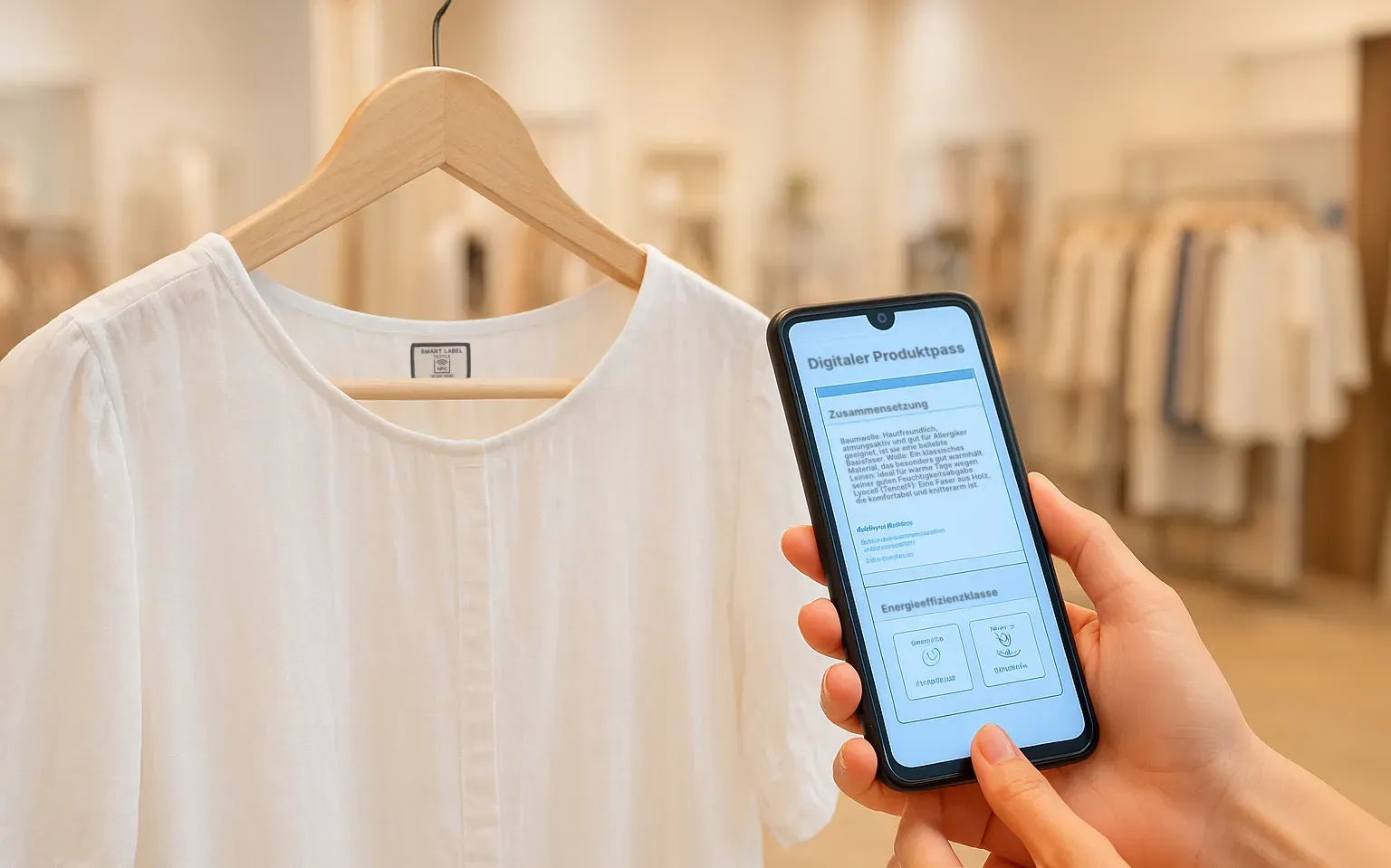
What is the digital product passport?
The goals of sustainable resource use, environmentally friendly product development and the EU's climate neutrality target for 2050 pose a major challenge for many companies. To achieve these goals and ensure the competitiveness of companies, a circular economy must be created. The digital product passport (DPP) is the key enabler for the creation of a circular economy. The DPP is a data set that digitally maps the life cycle of a product. It provides all parties involved in the production of a product with important information on the materials used, production, and methods of reuse, repair, and recycling of the product. This creates transparency for all parties, enabling them to make informed and sustainable decisions and develop sustainable business models.
Reduce, Reuse, Recycle!
In 2020, the European Commission adopted the Green Deal. The aim of the Green Deal is to create a modern, competitive and resource-efficient economy in the EU in order to make the EU a climate-neutral continent by 2050. This requires not only the creation of a pollution-free environment, but also a competitive and climate-neutral circular economy.
The circular economy aims to provide citizens with high-quality, safe products that are efficient, affordable and durable. The motto here is: Reduce, Reuse, Recycle! The aim of the circular economy is to reuse resources and products that have already been developed and to repair products that are no longer functioning. To this end, products should be recycled in an environmentally friendly manner at the end of their life cycle. This achieves climate-friendly and sustainable value creation.
The digital product passport (DPP) is intended to support the achievement of these goals. The digital product passport collects and provides comprehensive information about the origin, manufacture, use, chemical composition, properties and subsequent disposal of a product. This means that all data from all phases of the product life cycle is centrally summarised. The DPP is often referred to as the digital twin of the physical product, as it provides the entire life cycle of the product and all relevant information added along the entire value and supply chain in a single data set.
This information helps the various players in the value and supply chain, such as raw material producers, product manufacturers, retailers, consumers, repair shops and waste management companies, to make informed and sustainable decisions.
But how exactly can the DPP help the various stakeholders?
The following section provides an example of how the DPP can be integrated into the product cycle of a washing machine.
Raw material producers
Raw material producers use the DPP to send data on the origin, conditions and properties of the raw materials used. One example of this is a washing machine drum made of stainless steel. Stainless steel consists mainly of the elements iron, chromium and carbon. These elements are processed into stainless steel with the addition of other elements such as nickel to increase the corrosion resistance of the stainless steel and protect it from rust. As the corrosion resistance of the stainless steel increases, so does the quality of the washing machine drum. This information can be passed on to the washing machine manufacturer via the DPP. Based on this, the manufacturer can assess whether the proportions of alloy metals are suitable for the production of its washing machine and the desired quality. In addition, the manufacturer has the option of tracking the raw materials and assessing their sustainability.
Manufacturers
Manufacturers use these raw materials to build washing machines. A washing machine consists of various components and materials. Among other things, a washing machine has a housing, which is usually made of painted steel, a plastic lid and a stainless steel drum. There are also different designs for washing machines, such as front-loading and top-loading washing machines. Manufacturers supplement the product passport with information on the materials used, the design, the environmental impact of the washing machine's production, repair options, the availability of spare parts and disposal. Other information entered by the manufacturer in the DPP that is important for retailers and consumers includes information on electricity and water consumption (energy efficiency class), spin speed, capacity, noise level during washing, and instructions for use.
However, manufacturers not only send information to other players via the DPP, they also receive information themselves. Manufacturers receive information from raw material producers about the origin, conditions and quality of the raw materials, and they receive feedback on the washing machine from retailers. After production, the washing machine is transported to retailers for sale.
Retail trade
With the help of information provided by the manufacturer, such as energy efficiency class, capacity and instructions for use, retailers can provide consumers with transparent information about the sustainability and quality of the washing machine. This allows the information sent via the DPP to be used profitably. In addition, retailers can use this information to make an informed decision about whether to include the product in their range. At the same time, they provide the manufacturer with feedback on sales figures and customer feedback on the washing machine. This rapid transfer of information enables the manufacturer to revise their product at an early stage.
Consumers
After scanning the DPP, consumers gain access to important information about the washing machine's energy efficiency class, environmental friendliness, washing quality, automatic dosing system and instructions for use. They also receive information about repair options for the washing machine and disposal at the end of its product life cycle. All this information supports conscious purchasing decisions and sustainable consumption.
Repair shops
Repair shops receive detailed information about washing machine repairs and the availability of spare parts via the DPP. This information can be used to increase the longevity of washing machines and prevent electrical appliances that are actually in good working order from being disposed of unnecessarily. The repair shops, in turn, send information about the condition and components of the washing machine to the manufacturers.
Waste management
At the end of its product life cycle, the washing machine must be disposed of. Waste management companies receive information via the DPP about the composition of the individual components of the washing machine, their quality and how well they can be recycled. For example, the stainless steel washing machine drum can be recycled or, if it is in good condition, reused. Other components, such as the plastic lid, are disposed of differently. Sharing this information promotes efficient recycling processes and waste reduction.
All stakeholders have the opportunity to quickly and easily access the product information that is important to them. The economic advantage here is that they are working together towards a circular economy. The DPP thus enables the simplified exchange of a wide range of information between the various stakeholders. Companies that use the DPP can also set themselves apart from the competition.
But consumers also receive important information about the environmental friendliness, repair options and disposal of products, which they can use to guide their purchasing decisions. This also strengthens consumers' confidence in sustainable products.
The DPP will be introduced for iron and steel from 2026 and will be mandatory for batteries, textiles and electrical appliances from 2027. Further information can be found in the first work plan issued on 19 April 2025. This means that companies will soon have to consider not only what information is important for the individual players, but also which technical device should be used to read it.
DPP meets NFC!
The DPP can be read via an NFC tag, a QR code or an RFID tag attached to the product. The QR code is often considered the only option. Although the QR code is a cost-effective solution, it has many weaknesses. QR codes are read using an optical image recognition process. This means that good lighting and contrast conditions are required for them to be read. In the event of a power failure or poor lighting conditions, such as those found in a factory, there is a risk that the QR code can no longer be read. In addition, environmental factors such as sunlight, dirt and water can cause the QR code to fade or become dirty, making it unreadable. This can hinder a sustainable production process along the value chain and defeat the actual purpose of the DPP. NFC tags can also be read in the dark. In addition, NFC tags can only be impaired in their function by physical damage and they break if they are bent or exposed to extreme temperature fluctuations. This makes an NFC tag a durable replacement for the QR code. Find out more about the differences between QR codes and NFC tags here.
Another problem is the size of the QR code. The more data stored on the QR code, the larger the QR code becomes. The amount of data stored on a DPP is not fixed, but varies depending on the product category. For example, more data can be stored on the DPP of a washing machine or a battery than on the DPP of a garment. For example, if the DPP of a battery contains a lot of information and a QR code is used as the data carrier for the DPP, this QR code may be so large that it covers the entire surface of the battery and can no longer be read properly. However, if a smaller QR code were used, there would be a risk that not all the information that is important for the respective stakeholder would be displayed.
An NFC tag is the solution here. This allows a lot of information to be stored on an NTAG215 or an NTAG216 and the NFC tag still remains small. The NFC tag can either be attached to the product using a sticker or magnet, or integrated directly into the product. This also allows for “invisible” integration into the material. You can find out how NFC tags differ from RFID here.
NFC has 2 practical uses for the digital product passport: structuring information and providing information.
Structure information
The individual players in the value chain, with the exception of consumers, structure and maintain the information they store in the DPP and then pass it on to other stakeholders. It is important that they carefully consider what information they need to pass on in order to facilitate further processing of the product. All actors must enter the information in the DPP that they are legally obliged to provide. This ensures that all information relevant to each actor is presented in a structured manner. The information to be recorded and made available in the DPP is specified in product-specific delegated acts within the framework of the "Ecodesign for Sustainable Products Regulation (ESPR)" and where applicable, in other legal provisions.
As a rule, the following information should be stored on the DPP:
- Materials used to make the product
- Percentage of materials that can be recycled
- Product description
- Information about origin
- Information about the product's life cycle (including transport and distribution channels)
- Information on environmental impact (e.g. carbon footprint, energy and water consumption)
- Information on safe use of the product
- Instructions for repair and reuse of the product
- Recycling information
- Type of disposal
Provide information
It is clear that a lot of information is stored on the DPP, but not all of this information is important for every stakeholder. When purchasing a washing machine, it is important for consumers to know about the size, energy efficiency and maintenance of the washing machine. However, it is less important for consumers to know what materials each individual component of the washing machine is made of. This presents a challenge in terms of forwarding the relevant information to the various stakeholders. We can help! As a company specialising in NFC tags, we can encode the DPP in such a way that all stakeholders involved in the product life cycle are directed to the landing page that is relevant to them. This enables consumers to be directed to the product's website when they scan the NFC tag, where they can access the company's services. This makes it easy for them to contact the manufacturer and, for example, book a service or purchase a product.
The Open-dpp design tool is also available for this purpose. This tool enables manufacturers to create and customise legally compliant product passports for all products. Furthermore, user-defined business processes can be integrated.
In addition to coding, we supply the technical device and interface that enables the relevant parties to view the important information in the DPP. Optimising work processes within your own company is always a laborious task. But if you already have a technical device that allows you to quickly and easily forward all information to various parties, you have already overcome one obstacle. So please do not hesitate to contact us if you have any questions and get in touch with us.
What opportunities does the DPP offer?
- Increased environmental transparency along the supply chain and product life cycle
- Sustainability can be guaranteed throughout the entire value and supply chain
- Higher recycling rates can be achieved
- Repair and maintenance information enables a longer product life
- Greater transparency increases trust and perceived authenticity in your own brand
- Manufacturers and consumers can make informed sustainable decisions
- All important information is visible at a glance and can be accessed quickly
- The DPP can be written with a wealth of information via an NFC tag
- NFC tags are durable, preventing the DPP from becoming unreadable and lost
Preliminary conclusion
The Digital Product Passport (DPP) is a key instrument for implementing European sustainability and climate targets. It creates transparency across the entire life cycle of a product and enables all stakeholders to make informed, sustainable decisions – from raw material extraction to disposal. The DPP promotes the circular economy, supports resource-efficient management and strengthens consumer confidence in sustainable products. The use of modern, robust technologies such as NFC tags in particular makes the DPP efficient, durable and user-friendly. Manufacturers who integrate the DPP at an early stage not only secure a competitive advantage, but also make an active contribution to environmental protection and climate neutrality.